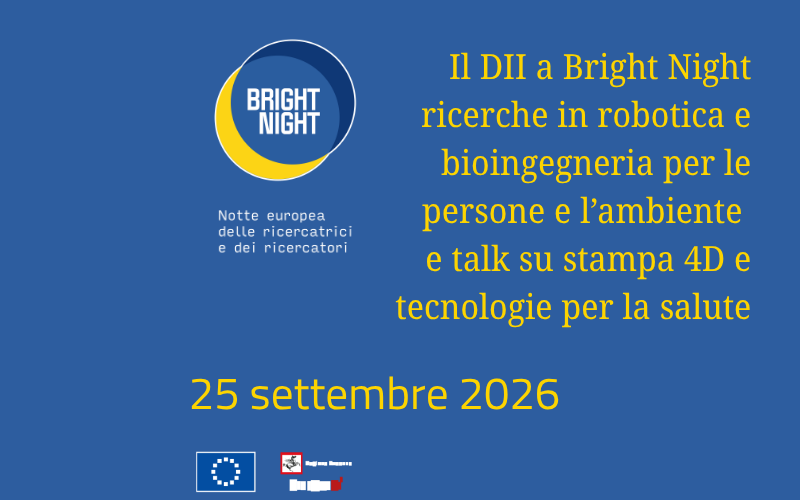
Il DII vi aspetta alle Logge dei Banchi a partire dalle 16 con le ricerche di frontiera in robotica e bioingegneria. Inoltre, in Largo Ciro Menotti talk sulle tecnologie di frontiera per la salute. ...
Leggi tutto

Advances in Digital Technologies and Human-centric ICT - DII workshop 2025

15 Dicembre 2025
1270
Dec 15, 2025
Aula Magna U. Dini h 9:00
Aula Magna U. Dini h 9:00
Registration Form LINK
PROGRAMME
9.00-9.05 Institutional Welcomming
9.05-9.20 DII Status and Future Prospects, Sergio Saponara
9.20-10.50 Woman in Engineering & Human-centric ICT
Chair: C. Bernardeschi
9.20-9.50 Sara Condino - Human-Centric Augmented Reality: from Surgical Guidance to Training Simulation
9.50-10.20 Chiara Magliaro - Do minibrains count lambs for falling asleep?
10.20-10.50 Mimma Nardelli - Let’s Music! A Low-Cost Route to Wellbeing from Early Life to Adulthood
10.50-11.20 DII Competence Center 5.0, G. Stea
11.20-12.50 Digital Engineering Technologies
Chair: A. Caiti
11.20-11.50 Giacomo Bacci - Always connected, always located: satellite technologies nobody can help without
11.50-12.20 Pericle Perazzo - The Hitchhiker’s Guide to IoT Security: from Blockchain to Satellites
12.20-12.50 Sebastiano Strangio - Analog Neuromorphic Chips in CMOS: Toward Intelligent Edge Systems
12.50 Xmas DII Light lunch
SPEAKERS
Sara Condino
Understanding the limitations of traditional head-mounted displays is the foundation for creating interfaces that integrate the real and virtual worlds coherently, intuitively, and effectively. A truly human-centered augmented reality can enhance surgical guidance and simulation, ensuring effectiveness, safety, and a high level of user confidence in system interaction.
Sara Condino received her master’s degree in biomedical engineering with honors in 2008 from the University of Pisa, and in 2012, she was awarded a Ph.D. in Technologies for Health: Evaluation and Management of Innovations in the Biomedical Sector from the same university.
In 2008, she collaborated with the Scuola Superiore Sant’Anna on European research projects in the field of robotic surgery, and subsequently pursued her doctoral studies at EndoCAS, Center of Excellence for Computer-Assisted Surgery at the University of Pisa, which became an Interdepartmental Center in 2022. Since November 2017, she has been affiliated with the Department of Information Engineering (DII) at the University of Pisa, where she will hold the position of Associate Professor starting in 2025.
Her scientific activity is carried out within the DII and at the EndoCAS Research Center, where she focuses on the design, development, and testing of medical and surgical devices, as well as innovative simulation environments for medical and surgical training based on Extended Reality (XR) technologies. In May 2022, she joined a NATO STO working group dedicated to assessing the effectiveness of XR technologies for medical training.
She was a founding member of e-SPres3D s.r.l., a spin-off company of the University of Pisa and Scuola Superiore Sant’Anna, specializing in 3D modeling services for surgical planning and medical simulation systems. Sara Condino is the author of approximately 90 indexed scientific publications and 6 patents of industrial relevance. She currently leads the University of Pisa research team in a project focused on the engineering and clinical validation of an augmented reality headset designed as a neuro-navigation tool for the treatment of supratentorial brain tumors.
Chiara Magliaro

The real-time monitoring of cellular behaviour in in vitro constructs at different complexity (from traditional monolayers, up to organoids) is crucial for defining quantitative metrics for determining the physiological relevance of engineered constructs
Chiara Magliaro got her PhD with honors in 2016. For the high quality of her work, she also got the certification for the European Doctorate (Doctor Europaeus) and the Massimo Grattarola award for the best Italian PhD thesis in neuroengineering. She won for two years the Fondazione Umberto Veronesi Post-Doctoral Fellowship, in 2018 and 2019. Actually, she is an Associate Professor at the Department of Information Engineering and an affiliate researcher at the Research Center "E. Piaggio".
Her research mainly focuses on the development of imaging methods for tissue processing, single neuron segmentation and 3D morphometric extraction from datasets representing densely-packed neurons in their native arrangement within the brain or in advanced 3D cellular brain models. Moreover, she develops oxygen and metabolism measurements in vitro and allometric scaling. The real-time monitoring of cellular behaviour in in vitro constructs at different complexity (from traditional monolayers, up to organoids) is crucial for defining quantitative metrics for determining the physiological relevance of engineered constructs. These aspects are all integrated within NAP, an European Innovation Council Pathfinder project she is coordinating, which aims at developing a model of the human sleep and its alterations starting from advanced cellular models of the human brain, the so-called cerebral organoids, to be exploited for identifying ealy stage indicators of neurodegenerative diseases.
Mimma Nardelli

Biomedical signal processing and wearable monitoring for characterization and modeling of nonlinear physiological dynamics in both clinical and healthy populations.
Mimma Nardelli received her Ph.D. degree in Information Engineering from the University of Pisa in 2017. She is currently an Associate Professor with the Department of Information Engineering at the University of Pisa, where she lectures in the Cybersecurity and Bionics Engineering programs. Since 2013, she has been a Fellow at the Research Center “E. Piaggio”. Between 2015 and 2016, she was a Visiting Fellow at the Biomedical Signal Interpretation and Computational Simulation (BSICoS) group of the Aragón Institute of Engineering Research, University of Zaragoza (Spain). In 2017, she received the Ph.D. Thesis Award “La BIOINGEGNERIA”, conferred by the Italian National Group of Bioengineering (GNB), in recognition of the scientific quality of her doctoral research. She is the author of more than 70 publications, including peer-reviewed journal articles, contributions to international conferences, and book chapters. She served as a Program Committee Member for the 11th and 13th Conferences of the European Study Group on Cardiovascular Oscillations (ESGCO). She serves as a reviewer for several international journals and as an Associate Editor for Nature – Scientific Reports.
Her main research interests include biomedical signal processing and wearable monitoring. Applications focus on the characterization and modeling of nonlinear physiological dynamics in both clinical and healthy populations. In this workshop, she will share insights from her research exploring how musical stimulation influences cardiorespiratory physiology. She will present experimental designs and key findings from studies investigating autonomic modulation in preterm infants and cardiovascular synchronization in adult dyads.
Giacomo Bacci
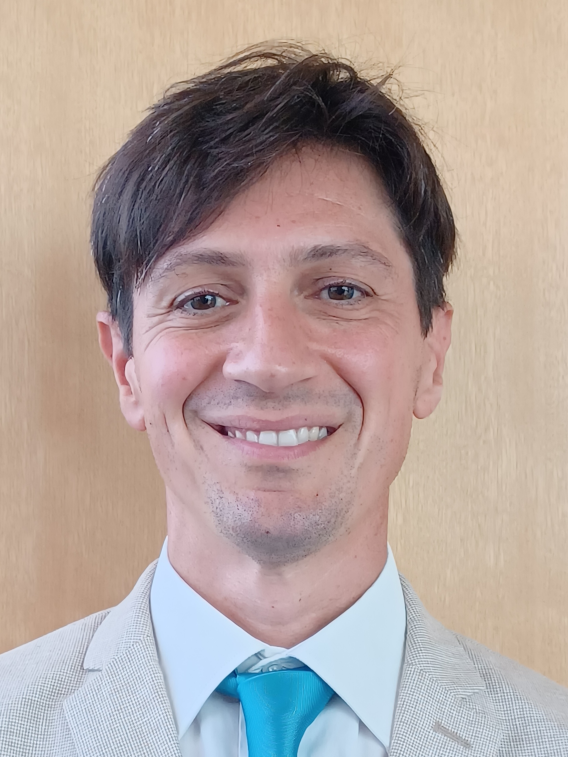
In recent years, satellite communications have experienced rapid growth in popularity, thanks to many significant technological advancements and due to changes in the geopolitical scenarios around the globe. Yet, several open challenges must be addressed before satellite systems can be seamlessly integrated into emerging 6G networks and next-generation position-navigation-timing (PNT) services.
Giacomo Bacci received Ph.D. degree in information engineering from the University of Pisa in 2008. From 2008 to 2014, he was a post-doctoral research fellow with the University of Pisa. From 2012 to 2014, he was also enrolled as a visiting post-doctoral research associate with Princeton University, United States. From 2015 to 2021, he was a product manager for interactive satellite broadband communications at MBI Srl, Pisa. Since 2022, he joined the University of Pisa, where he is now an associate professor. Since 2023, he is a Senior Member of the International Union of Radio Science (URSI) and, since 2024, he is a Senior Member of the Institute of Electrical and Electronics Engineers (IEEE). Prof. Bacci is the recipient of the FP7 Marie Curie International Outgoing Fellowships for career development (IOF) 2011 GRAND-CRU, the Best Paper Award from the IEEE Wireless Communications and Networking Conference (WCNC) in 2013, the Best Student Paper Award from the International Waveform Diversity and Design Conference (WDD) in 2007, and the 2014 URSI Young Scientist Award.
In recent years, satellite communications have experienced rapid growth in popularity, thanks to many significant technological advancements and due to changes in the geopolitical scenarios around the globe. Yet, several open challenges must be addressed before satellite systems can be seamlessly integrated into emerging 6G networks and next-generation position-navigation-timing (PNT) services.
This talk is structured in two parts. The first part introduces a multi-satellite formation strategy designed to enhance non-terrestrial network (NTN) connectivity, highlighting how coordinated satellite clusters can improve coverage, robustness, and throughput. The second part presents recent advances in waveform design aimed at increasing the positioning accuracy of next-generation low-Earth-orbit (LEO) PNT constellations.
Pericle Perazzo

Addressing critical challenges in secure and privacy-preserving computation by using and enhancing blockchain and homomorphic encryption. Blockchain’s decentralized architecture offers transparency and immutability, while homomorphic encryption enables computations on encrypted data without revealing sensitive information. Key research directions include Central-Bank Digital Currency (CBDC) and private neural networks.
Pericle Perazzo is Associate Professor at the Department of Information Engineering of the University of Pisa. He received the Master degree cum laude in Computer Engineering in 2010 and the Ph.D. degree in Information Engineering in 2014, both from the University of Pisa. In 2013 he had been Visiting Researcher in the Institute for Parallel and Distributed Systems (IPVS) of Stuttgart, Germany. Pericle Perazzo authored more than 50 scientific papers, published in international journals or conference proceedings, and he is inventor of two US patents. He has been scientific responsible for multiple research contracts funded by important private companies, and Associate Editor of the IEEE Transactions on Circuits and Systems for Video Technology.
Sebastiano Strangio
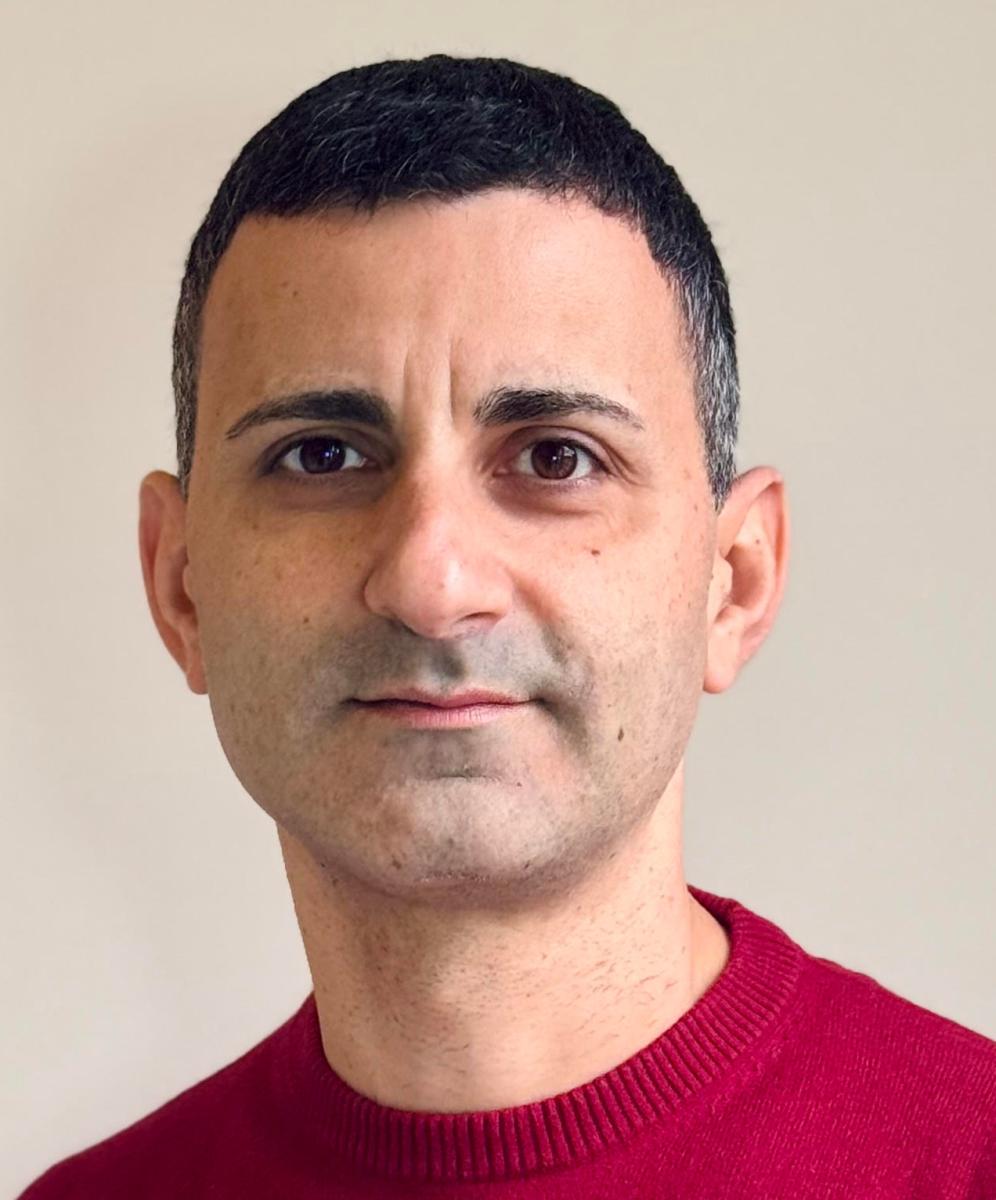
Design of analog integrated circuits for neuromorphic chip applications, aimed at embedding intelligence directly into sensors and peripheral devices, reducing reliance on cloud or datacenter processing, and enabling energy-efficient, low-latency signal processing at the edge for the next generation of smart, distributed electronic systems.
Sebastiano Strangio received his Bachelor’s degree (2010), Master’s degree (2012), and Ph.D. (2016) in Electronic Engineering, all from the University of Calabria. He was a visiting student at the IMEC research center (Belgium) in 2012, where he worked on innovative resistive RAM memory technologies, and a visiting researcher at Forschungszentrum Jülich (Germany) in 2015 under a DAAD research grant, focusing on experimental tunnel field effect transistor (TFET) devices. He held a temporary research associate position at the University of Udine (2013–2016), working on the simulation and modeling of circuit blocks implemented with TFETs.
After a brief industrial experience at the LFoundry microchip manufacturing plant (Avezzano, 2016–2019) as an R&D Process Integration and Device Engineer, where he worked on the development of a CMOS image sensor technology platform, he joined the University of Pisa, first as a junior Assistant Professor (RTD-A, 2019), then as Tenure-Track Assistant Professor (RTD-B, 2022), and is now Associate Professor in the field of Electronics.
He has been a Senior Member of the IEEE since 2023 and is the co-recipient of the 2025 IEEE TCAS Guillemin–Cauer Award.

Dipartimento di Ingegneria dell'Informazione
Via G. Caruso 16 - 56122 - Pisa
Tel +39 050 2217511 - info@dii.unipi.it
PEC: ing.informazione@pec.unipi.it
Info Didattica: didattica@dii.unipi.it
P.I. 00286820501 - C.F. 80003670504