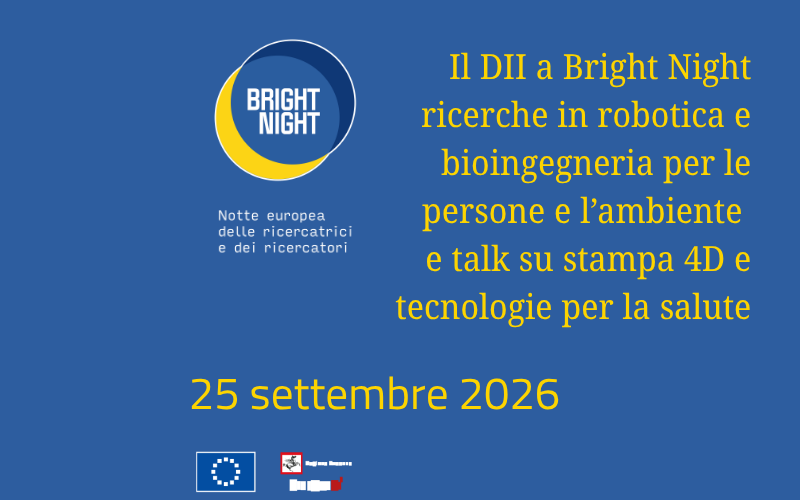
Il DII vi aspetta alle Logge dei Banchi a partire dalle 16 con le ricerche di frontiera in robotica e bioingegneria. Inoltre, in Largo Ciro Menotti talk sulle tecnologie di frontiera per la salute. ...
Leggi tutto

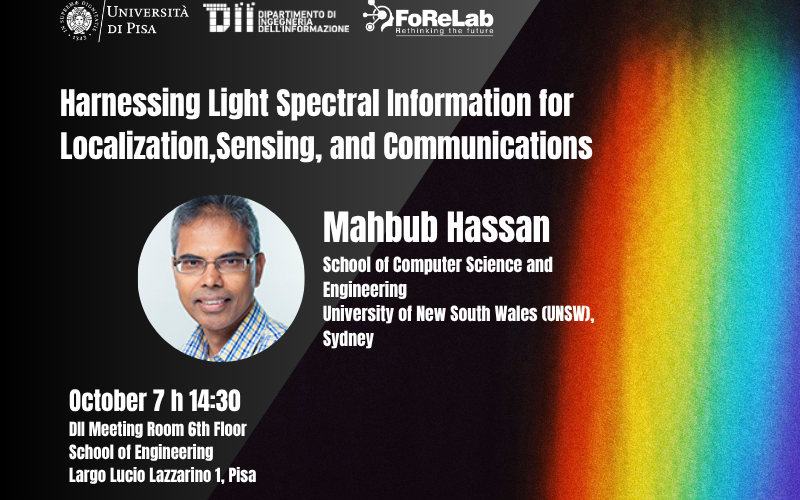
Harnessing Light Spectral Information for Localization, Sensing, and Communications
07 Ottobre 2026
16
Mahbub Hassan, University of New South Wales (UNSW), Sydney
Oct 7 h 14:30
DII meeting room 6th floor, School of Engineering
Largo L. Lazzarino 1 Pisa
Abstract
Ordinary light continuously interacts with the physical environment, yet its rich spectral dimension remains largely untapped for ambient intelligence. This seminar highlights our multi-year efforts to establish Light Spectral Information (LSI) as a foundational paradigm for ubiquitous localization, sensing, and communications. We demonstrate that everyday materials shape light across wavelengths to create ambient, location-specific "spectral fingerprints," enabling infrastructure-free positioning (Spectral-Loc) and passive, device-free human sensing through wavelength-dependent occlusion (Iris). To overcome physical measurement bottlenecks, LiDARSpectra shows how spatial-spectral fields can be computationally reconstructed via spectral ray tracing and multi-modal fusion. LightLLM enables robust cross-environment generalization by integrating Knowledge Graph spatial modelling with the world-knowledge of pretrained LLMs. Beyond sensing, Helios-CSK achieves filter-free colour data decoding using diverse solar cell materials and smart feature extraction. Together, these works point toward a future of light-aware ubiquitous systems where LSI is seamlessly acquired, modelled, and exploited using low-cost, energy-harvesting, and unconventional platforms.
Bio
Mahbub Hassan is a Full Professor in the School of Computer Science and Engineering at the University of New South Wales (UNSW), Sydney, Australia. His research contributions span wireless and mobile networking, sensing, and emerging networked systems. He served as an IEEE Distinguished Lecturer from 2013 to 2016 and is the author of Wireless and Mobile Networking, CRC Press 2022. Prof. Hassan is currently an Associate Editor for IEEE Communications Surveys &
Tutorials, where he received the Exemplary Editor Award, as well as for IEEE Transactions on Network Science and Engineering and the Proceedings of the ACM on Interactive, Mobile, Wearable and Ubiquitous Technologies.
He is recognised in the Stanford/Elsevier ranking of the world’s top 2% scientists. More information is available at http://www.cse.unsw.edu.au/~mahbub.

Dipartimento di Ingegneria dell'Informazione
Via G. Caruso 16 - 56122 - Pisa
Tel +39 050 2217511 - info@dii.unipi.it
PEC: ing.informazione@pec.unipi.it
Info Didattica: didattica@dii.unipi.it
P.I. 00286820501 - C.F. 80003670504