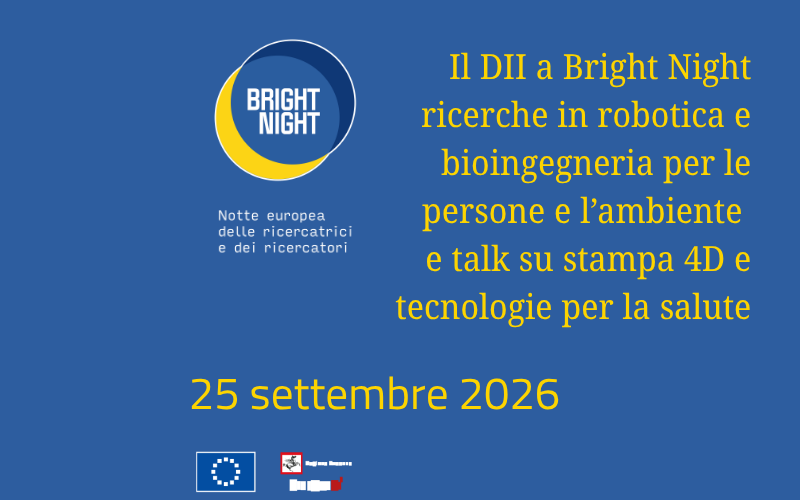
Il DII vi aspetta alle Logge dei Banchi a partire dalle 16 con le ricerche di frontiera in robotica e bioingegneria. Inoltre, in Largo Ciro Menotti talk sulle tecnologie di frontiera per la salute. ...
Leggi tutto

Networking for Distributed AI
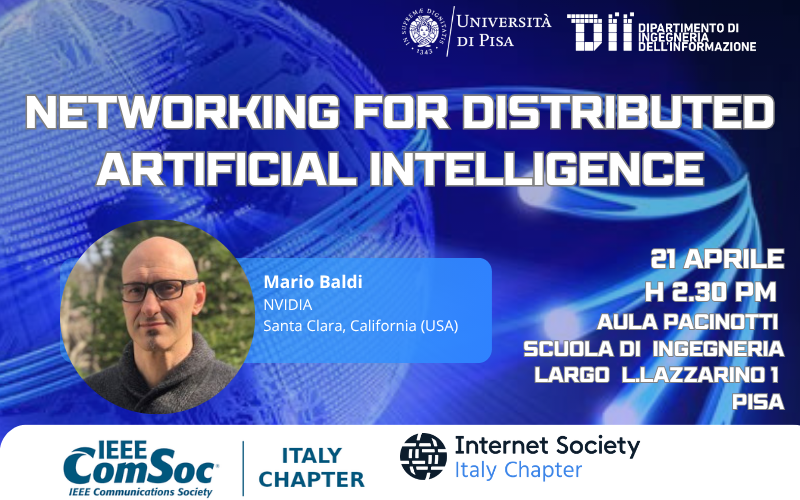
21 Aprile 2026
1239
Mario Baldi NVIDIA - USA (Santa Clara - California)
21 aprile h 14:30 Aula Pacinotti, Scuola di Ingegneria Pisa
Abstract
Distributed AI workloads are unique in the way they make use of the network. As a consequence, traditional networking solutions are not ideal for interconnecting the massive number of processors deployed in clusters for AI training and inference. Given that the network plays a key role in Distributed AI’s performance and power consumption, academia and industry have devoted an enormous amount effort to develop specialized solutions.
After analyzing the unique networking requirements of distributed AI workloads, this talk describes the network architectures commonly used to achieve the extreme scale of AI clusters and the standard protocol stacks developed for this specific context, covering both scale scale out and scale out domains.
Bio
Mario Baldi is a Distinguished Architect at NVIDIA, Networking Software and System Architecture. Besides being a tenured professor for over two decades, Mario held various positions in startup and established companies in the computer networking industry, as well as several visiting professorships at Universities in four continents. He is currently serving as the Co-chair of the p4.org Architecture Workgroup. He has authored over 150 scientific publications and two books; he is an inventor on 36 issued patents and several more under review. While more recently his focus has been on optimizing networking for distributed AI workloads, over the years, Mario’s research and engineering work has spanned across various computer networks-related areas, including programmable data planes, big data analytics, trust in distributed software execution, internetworking, high performance switching, optical networking, quality of service, multimedia over packet networks. Mario holds an M.S. with honours (Summa Cum Laude) in Electrical Engineering and a Ph.D. in Computer and Systems Engineering, both from Politecnico di Torino, Italy.

Dipartimento di Ingegneria dell'Informazione
Via G. Caruso 16 - 56122 - Pisa
Tel +39 050 2217511 - info@dii.unipi.it
PEC: ing.informazione@pec.unipi.it
Info Didattica: didattica@dii.unipi.it
P.I. 00286820501 - C.F. 80003670504