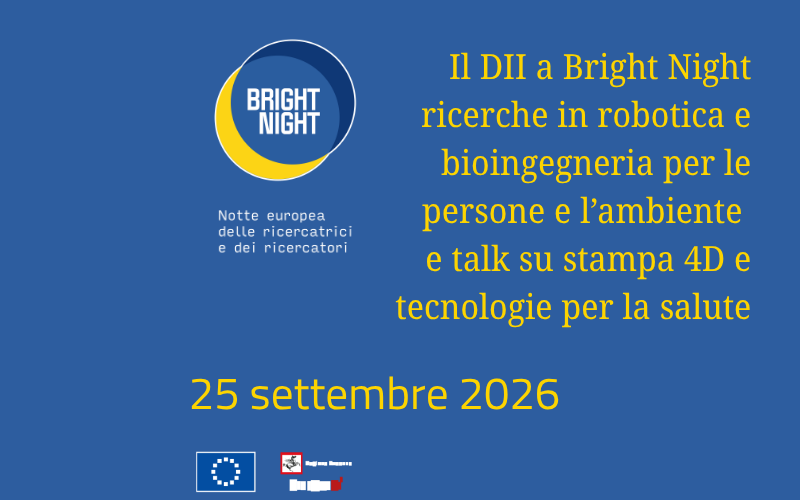
Il DII vi aspetta alle Logge dei Banchi a partire dalle 16 con le ricerche di frontiera in robotica e bioingegneria. Inoltre, in Largo Ciro Menotti talk sulle tecnologie di frontiera per la salute. ...
Leggi tutto

AI in Maritime Applications: Limitations and Opportunities

30 Marzo 2026
560
Volker Bertram DNV - Det Norske Veritas Hamburg/Germany
Lunedì 30 marzo 2026 , ore 15:00, Aula Riunioni DII 6° Piano, sede di Largo Lazzarino
Abstract
This lecture looks at key technologies of Artificial Intelligence (AI), more specifically machine learning, in maritime application and with focus on own experience. From “traditional” applications such as pattern recognition and trend prediction, we move to speech recognition, language processing, gesture processing to Large Language Models and generative AI. We will see several successful applications, and several mildly entertaining failure stories that highlight the limitations of AI.
Bio
Volker Bertram is a naval architect and maritime engineer whose career spans both academia and industry, with a long-standing focus on ship design, hydrodynamics, and digital technologies for maritime applications. Over the years, he has held academic and research positions at leading institutions, including TU Hamburg, TU Berlin, INSEAN (Rome), and ENSTA Bretagne, and has been a visiting professor at the Technical University of Denmark, and the World Maritime University, Sweden. He currently serves as a guest professor at the World Maritime University in Malmö, Sweden and at Stellenbosch University, South Africa. Alongside his academic activity, he has built an extensive industrial career and since 2008 he is Senior Project Manager at DNV, where he works on advanced training and innovation in maritime engineering, particularly in areas such as digitalization, simulation, and emerging technologies including AI and autonomous systems. A distinctive aspect of his profile is his role as a community builder in maritime research. He is the founder and long-time organizer of several influential international conference series, most notably COMPIT (Computer Applications and Information Technology in the Maritime Industries), which has become a key forum for discussing topics such as digital twins, simulation, and autonomous shipping. His activities extend to other conference initiatives focusing on future ship technologies, computational methods, and robotics in maritime applications, contributing to shaping dialogue between academia and industry. Prof. Bertram has authored several hundred publications and two widely used books in ship design and hydrodynamics, and is known for his engaging approach to teaching and training, combining technical depth with a strong emphasis on practical relevance and innovation in the maritime sector.

Dipartimento di Ingegneria dell'Informazione
Via G. Caruso 16 - 56122 - Pisa
Tel +39 050 2217511 - info@dii.unipi.it
PEC: ing.informazione@pec.unipi.it
Info Didattica: didattica@dii.unipi.it
P.I. 00286820501 - C.F. 80003670504